|
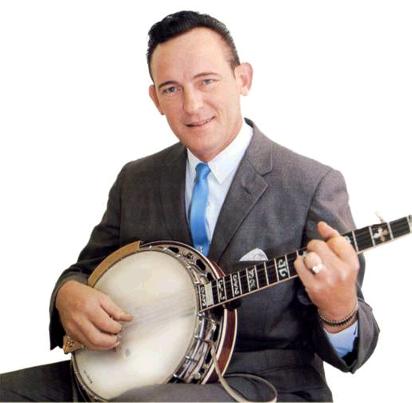
Don Reno BIO (Born: 2/21/1927 Died: 10/16/1984)
About Don
Virtually
unrivalled among his contemporaries for his mastery of the five-string
banjo, Don Reno teamed with Red Smiley to create some of the finest
bluegrass recordings of the postwar era -- a superb tenor vocalist and
songwriter, Reno also proved crucial to the emergence of the guitar as one
of bluegrass' lead instruments, and ranks alongside the likes of Bill
Monroe among the genre's true pioneers. Reno was born in Spartanburg, SC,
on February 21, 1927, and raised primarily in rural North Carolina; at age
five he built his first banjo, and as a teen backed the Morris Brothers
and Arthur "Guitar Boogie" Smith. He also recorded with Woody Guthrie and
was asked to join Monroe's Blue Grass Boys before serving in the military
from 1944 to 1946. Upon returning from duty Reno fronted a local South
Carolina band before replacing Earl Scruggs in the Blue Grass Boys, where
like his predecessor he was key in popularizing the three-finger roll
technique of banjo playing. (Courtesy of CMT)
"Not *months*, days. Very few days. They had played in Canada, then the week after Christmas came down through eastern NY, then may have played one or 2 more dates in NJ/ PA on the way home to Lynchburg. Red died in Philadelphia, did not get home. I saw them at Smokey Greene's Tavern, Rte 9, in South Glens Falls NY, I think about Dec 27-29 when looking at the 1971 calendar. It was NOT new years eve. It might have been Red's last show." (Courtesy of PJH) ******** THE
TRUTH - By an anonymous “used to be” – you figure out whom!
When I was eleven years old, back in the 1950’s, I found a 33-rpm record album in our local record store with a picture on the cover of Don Reno holding a 5-string banjo – I had to have it! I took it home, played it over and over, and thought there was at least three banjo players playing all at one time. Up to that time, I had never heard of Don Reno or heard anything like the 5-string banjo playing on that record album. I have never heard any other player that could equal the different tones and clearness of lead notes played clearly above the proper chords that Don Reno seemed to execute with ease on the “friendly-five” just about every time he played it. Don
Reno and I were intimate friends for over 28 years.
He was one of the nicest and most gracious professional musicians I
have ever known. He invited
me to travel from my home (600 miles) to stay at his home in Hollins,
Virginia, when I was barely a teenager, and when I took him up on it he
treated me as an equal from the first time I ever spoke to him.
He was always ready to show anyone how he did his thing on the
5-string and was constantly full of encouragement where music was
concerned. He helped me learn
the 5-string and gave me his indispensable advice, which was instrumental
in guiding my music career to being one of Mac Wiseman’s, Stoney
Cooper’s, Jimmy Martin’s, and Bill Monroe’s banjo players.
And yes, a number of times I even took Don Reno’s place in his
band when he was ill! In
my opinion, to this day, no one has ever equaled the uniqueness of his
arrangements of Wagner’s “Under The Double Eagle,” “The Beer
Barrel Polka,” “Limehouse Blues,” “John Hardy,” his break in
“I Know You’re Married,” and many more of his arrangements too
numerous to mention here. Unlike
other professional banjo players of yesteryear (and even today,) when Reno
played someone else’s composition on his banjo you could instantly
identify the melody because all the lead notes and correct chords were
just where they were supposed to be – his timing and dexterity were
impeccable. Don
Reno might be gone, but he will never be forgotten. (Courtesy of - A friend) ********
|