
[and a few comparisons]
 The
Melodic style of picking is often referred to as 'Chromatic' or 'Fiddle Scale'
style and is most often linked with the name of a great player called Bill
Keith, in fact, he has been credited with the creation of this style and some
even refer to it as 'Keith Style' It has to be said though that others were also
developing this style around the same time as Bill, some say even earlier and
another great name that emerged in this style is Bobby Thompson. I won't touch
on any 'Chicken or Egg' theories here because I like fried chicken and I also
like my eggs fried, if you get my drift ;-) With the advent of more contempory
music a lot more people are adopting this style of picking in preference to the
older Scruggs style which purists deem to be the only way that bluegrass should
be played. Newgrass has tempted many pickers to take the Melodic route while
many others embrace both styles and blend the two together with flawless seams.
It's extremely common now to hear pickers today performing a hard driving
Scruggs style tune interspersed with flashy chromatic/melodic tag licks. I
personally see nothing wrong in mixing the styles, letting them stand on their
own or even mixing the two with other styles, such as single string or Don Reno
style! I will try and adopt whatever it takes to belt out something that sounds
presentable to my ear. If the objective is to play a tune note for note, say a
fiddle tune, country song or even a Charlie Parker jazz lick... then the melodic
approach is the best way because it's scale based and if you know your scales
then you can grab all the notes wherever suits you best while following the
simple rule of using right hand finger rotation, i.e. Trying to avoid using the
same finger twice in a row. That sounds like I'm over simplifying the situation
but it's the basic concept. To get the notes you want sometimes requires some
strange rolls, strange that is, if you're moving into Keith from Scruggs style.
Inside rolls are often a feature where sometimes the only way to hit a required
note is on the second string with the middle finger. Another time your index
finger may have to take a trip across to the 4th string. An important point here
is - because each note is a melody note it has to be played correctly. There is
no room for error as each note is an integral part of the tune. If you miss out
a note it throws all your right hand picking patterns into disarray, if you play
an incorrect note it sticks out like a sore thumb and you'll undoubtedly have to
use the sore thumb as an excuse! In contrast, Scruggs style is a bit more
lenient and strict adherence to the melody is not as important. This is because
the style is chord based and relies on a lot of fill notes in between melody
notes, so if you happen to hit a note on an adjacent string by accident - it
forms part of the chord anyway and you can often get away with doing that,
particularly if you're improvising. Playing in melodic style can also be very
demanding on the left hand too and sometimes requires more than a few left hand
gymnastics in order to grab the notes. It depends how involved a particular tune
is and how many open strings can be used to effectively make the task of getting
the notes a little easier. Sometimes a good sprinkling of 'Stretcheroo' finger
contortions are needed in order to play certain tunes, while other answers may
involve learning tunes in a different tuning, in which case new scales need to
be learnt and different picking patterns. Getting a fast fiddle tune up to tempo
can also take much time and practice and it usually takes a seasoned picker to
play the more difficult examples. Some of the purists, while accepting the
Melodic style, would never be convinced that the 'Drive' 'Dynamics' and
'Syncopation' prevalent in Scruggs style bluegrass could be achieved in the
Keith style. The jury is still out! If you listen to Tony Trischka and Bill
Keith performing "Blackberry Blossom" together, you'll know you've
been treated to a virtuoso act. Also, listen to Allison Brown, Béla Fleck and
Ron Block when they play in Melodic style..... Draw your own conclusions.
The
Melodic style of picking is often referred to as 'Chromatic' or 'Fiddle Scale'
style and is most often linked with the name of a great player called Bill
Keith, in fact, he has been credited with the creation of this style and some
even refer to it as 'Keith Style' It has to be said though that others were also
developing this style around the same time as Bill, some say even earlier and
another great name that emerged in this style is Bobby Thompson. I won't touch
on any 'Chicken or Egg' theories here because I like fried chicken and I also
like my eggs fried, if you get my drift ;-) With the advent of more contempory
music a lot more people are adopting this style of picking in preference to the
older Scruggs style which purists deem to be the only way that bluegrass should
be played. Newgrass has tempted many pickers to take the Melodic route while
many others embrace both styles and blend the two together with flawless seams.
It's extremely common now to hear pickers today performing a hard driving
Scruggs style tune interspersed with flashy chromatic/melodic tag licks. I
personally see nothing wrong in mixing the styles, letting them stand on their
own or even mixing the two with other styles, such as single string or Don Reno
style! I will try and adopt whatever it takes to belt out something that sounds
presentable to my ear. If the objective is to play a tune note for note, say a
fiddle tune, country song or even a Charlie Parker jazz lick... then the melodic
approach is the best way because it's scale based and if you know your scales
then you can grab all the notes wherever suits you best while following the
simple rule of using right hand finger rotation, i.e. Trying to avoid using the
same finger twice in a row. That sounds like I'm over simplifying the situation
but it's the basic concept. To get the notes you want sometimes requires some
strange rolls, strange that is, if you're moving into Keith from Scruggs style.
Inside rolls are often a feature where sometimes the only way to hit a required
note is on the second string with the middle finger. Another time your index
finger may have to take a trip across to the 4th string. An important point here
is - because each note is a melody note it has to be played correctly. There is
no room for error as each note is an integral part of the tune. If you miss out
a note it throws all your right hand picking patterns into disarray, if you play
an incorrect note it sticks out like a sore thumb and you'll undoubtedly have to
use the sore thumb as an excuse! In contrast, Scruggs style is a bit more
lenient and strict adherence to the melody is not as important. This is because
the style is chord based and relies on a lot of fill notes in between melody
notes, so if you happen to hit a note on an adjacent string by accident - it
forms part of the chord anyway and you can often get away with doing that,
particularly if you're improvising. Playing in melodic style can also be very
demanding on the left hand too and sometimes requires more than a few left hand
gymnastics in order to grab the notes. It depends how involved a particular tune
is and how many open strings can be used to effectively make the task of getting
the notes a little easier. Sometimes a good sprinkling of 'Stretcheroo' finger
contortions are needed in order to play certain tunes, while other answers may
involve learning tunes in a different tuning, in which case new scales need to
be learnt and different picking patterns. Getting a fast fiddle tune up to tempo
can also take much time and practice and it usually takes a seasoned picker to
play the more difficult examples. Some of the purists, while accepting the
Melodic style, would never be convinced that the 'Drive' 'Dynamics' and
'Syncopation' prevalent in Scruggs style bluegrass could be achieved in the
Keith style. The jury is still out! If you listen to Tony Trischka and Bill
Keith performing "Blackberry Blossom" together, you'll know you've
been treated to a virtuoso act. Also, listen to Allison Brown, Béla Fleck and
Ron Block when they play in Melodic style..... Draw your own conclusions.
Below are the common scale picking patterns and left hand fingerings in the Key of G. first ascending and then descending. The object here is to completely familiarize yourself with these patterns. If you follow the correct left hand finger assignments and practice until you can play each scale smoothly then you can consider purchasing a fiddle tune banjo tab book or simply browse the web for some. You'll find a couple right here on my Tabs Page to start you off. If you don't like them, let me know - but if you do like them...still let me know... Have fun and practice hard!
Ascending Scale
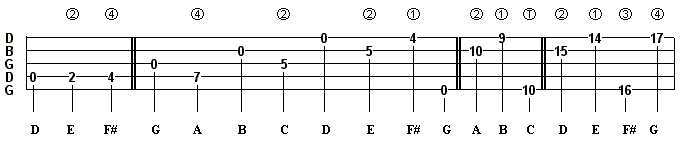
NOTE: Circled numbers denote left hand fingering and double bar lines indicate position shifts.
Play sounds
Descending Scale

You Are Visitor Number
|
|
Since July 16 2003
Website designed and created by Tony Geoghegan ©2000 All rights reserved. Contact Webmaster for permission to reproduce or copy any material from this website